


- Past
- Ready to view
Legacy migration: How to modernize 30y old system
In many mid-sized companies, the core business runs on decades-old software. In this live webinar, we show how we take these systems apart and put them on a credible migration path. Even with no source code.
- Free
- Real migration cases
- Even without source code
- CTOs
- IT leaders
- Decision-makers
- In English














LEGACY MIGRATION
What this webinar
is really about
You will exactly see
- How a running application is turned into a validated specification - with contract tests that prove the new system behaves identically
- How we analyze a system delivered as ~800 GB of raw server snapshots - with no source code
- How we freeze the legacy system in a Docker image, so the AI can re-run and verify it at any time during months of migration
- How decompilation, database mapping and UI automation reconstruct the real business logic
- How business-critical special logic - e.g. regulatory calculations deep in the article master data - is identified and preserved, so nothing gets lost
- How the module ends with a fixed-price offer, before a line of new code is written - and how the validated specification then flows straight into our AI-native development (the Riwers AI SDLC), where the proven system is mirrored one-to-one into a modern stack

- Two real cases shown live: a ~30-year-old Visual Basic system on Windows Server 2008 (vendor gone, no source code) put on a credible six-month path and a 20+ year-old Java system brought to the current stack step by step, with the frozen original as the reference
- No slide show. No AI sales pitch
- Hosted by our Legacy Migration Lead Alexander Benko and Co-founder Marco Dietrich - from real, ongoing projects
- Why "no source code" is the worst case we handle, not the typical one
- How every artifact you have (code, manuals, repository history) shortens the analysis
- Where AI genuinely changes the economics of legacy analysis - and where it hits hard limits
- An honest look, including the parts that were harder than expected
PRESENTERS
Who is hosting the webinar?
Riwers is an AI-native software factory for mid-sized companies. What we recommend in consulting, we run in our own development - including the migration of grown legacy systems.
Alexander Benko
Senior Developer, Legacy Migration Lead
Alexander leads Riwers' legacy migration competence team. He reconstructs and refactors decades-old systems with AI-driven protocols - from decompiled Visual Basic binaries to multi-week autonomous refactoring runs.
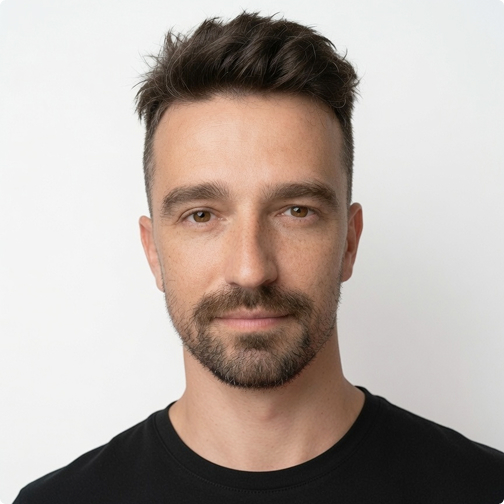
Marco brings 20+ years in IT, from software development to leading international delivery organizations. On migration projects, he owns the customer side: scoping, risk, and the fixed-price/fixed-date commitment.

Who is this
webinar for
Built for decision-makers responsible for a business-critical system nobody wants to touch.

This webinar is aimed at:
- CTOs, CIOs, IT leaders and heads of digitalization in mid-sized companies - technical understanding helps, but you don't need to be a developer
- Managing directors and executives responsible for a business-critical legacy system
- Companies whose vendor has disappeared, or whose system knowledge is about to retire
- Companies that still have source code and documentation, but a system that has become too risky or too expensive to change
- Organizations that had a rewrite quoted - and shelved it because of cost
Not intended for:
- Pure tool benchmarking
- Technical deep dives without business relevance
- Buzzword discussions without implementation
Between aspiration and reality
in medium-sized businesses
Perhaps this sounds familiar to you?
Vendor is gone and the knowledge with it
No one can fully say anymore what the system actually does.
Source code is missing or unreadable
This is exactly where classic migration projects fail on day one.
Platform underneath becomes a risk
Old operating systems and runtimes are a growing security and compliance issue.
Every rewrite so far was too expensive
The quotes you got were out of proportion to the value - so nothing changed.
What you will
take away
The reality-driven method
You see, step by step, how a running system is reconstructed: data model, business logic, interfaces and edge cases - until the system itself has become the specification. One thing the code alone never reveals is how people actually use the system - which is exactly why manuals and key users matter so much.
Contract tests as a safety net
You understand how observed behavior turns into tests that prove one thing: the new system behaves exactly like the old one.
The input checklist and the decision framework
You get a clear read on which artifacts accelerate a migration the most. And you see how to slice a grown system correctly: business-differentiating logic gets rebuilt, commodity functions like accounting, payroll or standard ERP are absorbed into proven standard software, and dead code is retired. That split is exactly what makes a fixed-price offer possible.
An honest assessment of AI, with real numbers
You learn where AI agents genuinely change the economics of legacy analysis and where they hit hard limits - including effort, timelines and lessons from ongoing projects, unpolished.
What if you knew exactly how to understand a system nobody dares to touch and what a realistic migration path costs before you spend a cent on the rebuild?
In this 45-minute session, we show you the method we use at Riwers: how a grown legacy system becomes a validated basis for the rebuild - without a big bang and without betting the company.
Want to start a new project?
Let’s talk.
Free initial consultation. 30 minutes. No sales pitch.